Hall of Fame Profile: Andy Murray
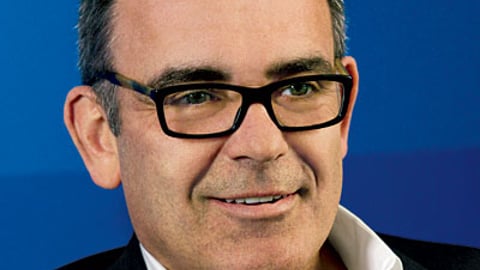
Andy Murray
Title: Senior vice president, creative, Walmart, Bentonville, Ark.
Direct reports: Alan Dranow, senior director, Walmart Heritage; Andy Johnson, senior director, advertising; Clint McClain, senior director, creative; Dale Treece, senior director, creative; Jaimi Cuadrado, senior director, strategic brand activation; Kay Roesing, director, operations; Ken Mantel, senior director, design; Leslie Watts, director, operations; Melissa Perry, senior manager, integration; Simona Rabsatt, director, marketing vendor management; Walter Porras, senior director, creative.
Education: Murray holds a bachelor’s in computer science from the Ohio Institute of Technology.
Hobbies: Golf, travel, long motorcycle rides on Sunday afternoons.
Andy Murray was inducted into the Hall of Fame on March 25 at a ceremony held in conjunction with the Shopper Marketing Summit and the Shopper Marketing Effie Celebration. He was inducted along with Erik Keptner, EVP, marketing, Ahold USA; and Julie Eddleman, marketing director, Procter & Gamble. Keptner was profiled in the February issue. Eddleman was profiled in the March issue.
After graduating from the Ohio Institute of Technology in 1984 with a degree in computer science, Andy Murray landed his first job as a field engineer at Electronic Data Systems. He subsequently moved through various roles at Procter & Gamble, including one on the Walmart customer team that brought him to Fayetteville, Ark. He left P&G in 1993 to become vice president of marketing and creative at DaySpring Cards, now a Hallmark Cards subsidiary. “While my first love professionally has always been technology and how it can disrupt categories, I’m equally passionate about the creative process and the power of story and ideas to drive change,” Murray says.
At 33, he left DaySpring to satisfy an entrepreneurial itch, armed with nothing more than a fuzzy idea and a 3-by-5-inch card posted on his fridge to remind him of his dream: to build a great company. He launched a brand agency working with universities and the P&G Walmart team, and that quickly evolved into a full-fledged shopper marketing agency, ThompsonMurray. After rapid growth in this new field, Murray sold his agency to Saatchi & Saatchi to create a new global entity, Saatchi & Saatchi X, a division focused solely on shopper marketing. Over the next six years, Murray stayed on as global CEO and opened offices in 13 countries. He has become widely recognized for his thought leadership in the emerging discipline.
Murray has worked with Walmart throughout his more than two-decade career, first on P&G’s nascent Walmart customer team, and then as an agency partner. Last September, he joined the retailer’s own ranks as SVP, creative. He says he brings to Walmart a desire to innovate in helping customers along the path to purchase and making marketing more customer-centric. The Path to Purchase Institute’s Patrycja Malinowska met with Murray in late January at his offices in Bentonville, Ark.
You’ve worked with Walmart for a long time. How does it feel to now be part of the internal team?
Murray: It’s interesting coming from the CPG side and the agency side, and now this. Seeing the customer world through three lenses has really changed the way I look at things. For example, when evaluating an idea from a CPG side you are looking primarily at your brand and growing your share of the category. From an agency side you are looking at, “Can you sell the idea through the stakeholders?” From a retail side, “Will this drive trips or in-store conversion?”
The reason I came to Walmart is first because I was invited to join the team. I’ve been in this community for many years and know the leaders up close and personal. Stephen [Quinn], Mike [Duke], Doug [McMillon], Duncan [Mac Naughton] and Bill [Simon] all have great vision for where they want to take Walmart and have built great teams. Second, the scale of the platform to make a difference is mind-blowing and humbling. It is the largest company in the history of the world, and the responsibility in marketing to lead by serving the customer and associates is a pretty clear task. Every day I wake up excited to take it on. There are still so many exciting things happening, especially in this world of shopper marketing and creative. Technology that for so long has been on the fringe is now starting to show up at scale in terms of changing shopper behavior.
What are your responsibilities?
Murray: I have the creative for advertising, which includes TV, Smart Network and all content, retailtainment, visual merchandising, the tab/FSIs, brand creative, associate communication, Heritage/Walmart museum, marketing operations, marketing vendor management – and perhaps a few other things [Quinn] assigns.
What does a typical day look like?
Murray: A day here is like no other day at any other company I’ve ever been. Every day is full on, from 7:30 a.m. to 6-ish. Because of the scale, the speed of retail and the amount of work, the only way you could do this is to have a set rhythm. I see almost every piece of work creatively. A big part of my week is patterned to accomplish this rhythm. Then you hit this big bump called “holiday,” and it is entirely another gear.
I started about two weeks before holiday, and it totally caught me by surprise. I had to decide to either dive in and be part of holiday in my role or sit on the sidelines and observe until January, as no one would have time to “onboard” me. So I chose to dive in and give it a go. It was the best decision I could have made. A bit insane, but worth it. You’re making so many important decisions really fast. Your eyes are on the competitive sale – what’s happening in the marketplace, what the customer is responding to – and reacting in real time to produce ads and print materials. And we couldn’t do it without strong agency partners.
But this is a family culture, so I feel very comfortable here. And it is very entrepreneurial for a company of this size. If I have an idea, my boss [chief marketing officer] Stephen Quinn is like, “Yeah, let’s go do it.” So you try to go fast, fail fast and fix fast, and continue to improve. It would make working anyplace else feel really slow. It can be addicting. I’ve kiddingly said, “You don’t join up at Walmart, you surrender.”
With all of that on your plate, do you get to stores a lot?
Murray: I do, actually, though never often enough. I tend to go with a merchant who can explain how things really work. Probably one of the best things about this job is getting next to the merchants who are doing the buying and see everything come alive in the store. That’s where you get some of your best ideas.
For your team, what is your top goal for the next year?
Murray: This is retail, you know, so more sales is always going to be important. For me, it is about elevating the creative so that it becomes a very important part of driving store traffic and building the brand. I am very interested in how we build that emotional relationship with the customer so that we get loyalty and continue to build the trust factor, and then make it compelling and inviting for her to shop at Walmart.
Moving on to a broader topic, how do you define shopper marketing?
Murray: It is really hard to define because the definition is a total circle, and I think the industry would be well served to get a better definition. There is a core piece of it that everybody pretty much agrees on, and when you go to that outer circle everybody comes at it differently based on their own competencies. What most people will agree with is that it is insight-driven; that you are going to be considering the retailer, the brand and the customer; that the work is about overcoming purchase barriers; that a sense of creativity, ideas and emotion is part of it; and that it is not just a tactical exercise. True shopper marketing has a good sense of an idea and a creative piece hopefully infused by good insights. Those are really core elements. Otherwise, it is just promotions.
And I do think that shopper marketing is looking at the whole path to purchase. It is that point of being prompted through those different behavior stages to repeat purchase and loyalty. When you start looking at shopper marketing as a list of tactics, that’s where people get a little bit lost. Is it direct mail, packaging, shopper-based design, category management? My answer is “Yes” to all of that, if we are talking about insight-based work with ideas that change behaviors.
What would you say is the key to creating a breakthrough shopper marketing program?
Murray: I would say two things: a super-good insight and the ability to execute. I see so many ideas – more so in this role, perhaps – that you just can’t execute at scale. [Earlier in my career] I did an RFP for a major CPG company that wanted to hire a shopper marketing agency, and I got to see some of the best in the business. We had people pitching that were coming from the consulting lens, we had pure shopper marketing agencies and we had design agencies. You would look at [pure shopper marketing agencies’] decks and you would have a hard time differentiating the way they talked about the shopper and the way they talked about their approach, which was very insight-based work. The consulting-type would usually come at the brief through data models that show you the levers to drive your growth, and then that leads to what the ideas are. The design agencies came at it from the construct of principles and your ideas will fit the principles. I’m not quite sure any of them by themselves would have been right, but you could see where the future might go, where you’d say, “Gosh, if I could have a supplier or partners who really understand all three of those, that might be pretty powerful.”
What is the key to successful retailer-manufacturer collaboration?
Murray: Conversation and making sure that you are tied in. There are a lot of streams of work happening between retailers and manufacturers, and the piece that’s more recently evolving is the marketing connection. How can we work better with the marketing teams of the suppliers to make sure that where we’re trying to go from a marketing perspective to the customer is shared and open, and we are clear and more aligned? That linkage hasn’t always been active, so you simply send the supplier to the merchant, leaving the retail marketer as more of an evaluator, or a person that says if it’s on brand or not.
I’m hoping to see more insights around a shared collaboration with the marketers, a lot of whom have great insights about the shopper in their category that we need to put into our thinking. I’m going to as many meetings as I can with suppliers to make those connections. Frankly, I think supplier agencies are a key part of coming up with ideas and often they are the ones that are least invited to the table.
Should the marketing agencies that Walmart works with play a specific role, either directly for Walmart or through the brands and suppliers?
Murray: I think the easy thing that any agency can do is spend time in the stores, look at what’s happening and what stands up as good quality. You see the strategy pretty fast as you walk the store and understand who that customer is. Also key is being a student of what’s happening with the online space and how omnichannel is really working.
We are trying to maintain trust with the customer about price leadership, so when you are looking at retailtainment ideas or in-store displays or things of that nature, we have to stay true to the core things that make Walmart Walmart.
Then, [agencies] should work with their partners to get more involved in some of the conversations. Where Walmart is a major part of their business plan, I’m open to a conversation about, “How can I play a role to help?” We are working on some things to make it easier for top agencies that do a lot of work with us to get connected better. I think there is a lot of waste in the total ecosystem of how we make shopper marketing come alive.
What is the most important aspect of Walmart’s strategy that brand marketers need to understand?
Murray: From a creative point of view, as we look at collaborating with suppliers on materials that go into the marketplace, it is about trying to understand Walmart’s brand and how the marketers’ brands fit in, especially as we look at things that they may not think about as much, like trips. Does this drive trips and total box? What role does the brand play in trip-driving when you look at marketing communication, and what role does it play in total box shopping?
How does Walmart’s marketing strategy today differ from 20 years ago when you first started working with the chain?
Murray: When I first started working with them, the in-store environment was fairly unstructured. In the beginning stages of shopper marketing – not just at Walmart but everywhere – everybody wanted to get into the next generation of category management and in-store displays, every category wanted to get redefined and every department wanted to become a unique experience. So the big question that emerged was, “What ties the store together?” At that point it was very much a supplier-driven approach to shopper marketing and in-store design. Then several retailers, Walmart included, saw the pendulum swing back in the other direction to clean-store environments. I think where we are today is coming back toward the middle where we can see collaboration but with a greater sense of rules. There’s a lot of innovation out there that we need to tap into to take advantage of that.
How does the plethora of new technology available today affect Walmart’s strategy?
Murray: Omnichannel, for sure. Our goal is to make the products that our customers want available anytime, anywhere they want to buy. Shoppers have three budgets – a time budget, a money budget and a frustration budget – and you’d better be working on all three.
We feel like we have some advantages in the physical locations that we utilize and develop behind. We are going to start seeing a very different kind of shopping environment that feels natural and intuitive, that doesn’t feel techno-heavy.
The technology will become invisible the more that we make the customer experience intuitive and based on human interaction, and so the best thing that could happen to get technology adopted and change the shopping experience is to be a master at human interaction. The competitive advantage is understanding the human condition and what makes us smile, what makes our life easier, and technology is a tactic to get that done. One of the reasons I really like this role is I’m trying to focus on raising creative from just an execution of ads to a set of principles that lets us tell better stories and provide better customer experiences. It is easy to build apps. It’s actually easy to do a lot of things now through technology. But for me it comes back to the creative challenge.
The media loves to position Walmart against Amazon.com, especially in the CPG marketplace. You mentioned you have physical locations as an advantage. What are the challenges?
Murray: Amazon is a great competitor. We are going to continue to work on and improve upon a lot of things that you can get with the online experience that are harder to do in-store, and technology can help with that. It is hard to walk down an aisle and know what the user reviews say about every item – things that online customers are experiencing that become a set of expectations about how to shop. Their expectations on ratings and product information are going to be just as high as if they were sitting at their home looking up stuff. So how you deliver that information in the store is partly a technical challenge, but it is also part of that storytelling. It will get easier to find things in stores; it is going to get easier to take some of those advantages of online shopping away.
With these technologies maturing, what will the typical Walmart store look like in 2020?
Murray: I don’t know what the technology is going to look like. But I have to believe we are still going to see people in physical stores. The idea of shopping in terms of only utility, and that we are just going to fix the utility through technology and it is all going to be home delivery – that you’ll never have to go see someone and you are just going to live in a cave – that’s not life. There is going to be emotion in it, there is going to be community. It is about picking up the fruit, interacting with people, looking at life, and touching and feeling things. Hopefully, the transaction part of it will become invisible. That would be the ultimate path. We’ll probably see technology replace self-checkouts. The humanity and the emotion and the joy of it are what go up as the technology makes it easier for the transaction part to go down.