Target Looks to Influence Shoppers Without Interrupting Experiences


At Target, the path to purchase increasingly intersects between shoppers’ phones and the store aisles. Connecting those touchpoints — and determining if they generate additional sales — was a central theme at The Roundtable, the company's retail media executive forum held in New York earlier this month.
Artificial intelligence is unsurprisingly becoming part of that journey, with AI-driven traffic to Target increasing 2,000% year over year in the first quarter, according to Matt Drzewicki, senior vice president at Roundel, its retail media arm.
Digital engagement is entrenched at the store, with same-day services like buy-online-pickup-in-store representing two-thirds of digital sales, and 70% to 80% of Target shoppers looking at their phones in the aisles.
As many as 90% of shoppers buy something that wasn’t on their list, said James Gourde, senior director of Roundel’s partner solutions group.
“People are really open in a Target environment to discover,” he stressed.
See also: Fun brand collabs land at Target
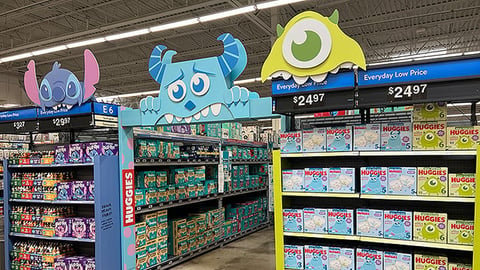
Shoppers are using their phones in stores to look at product reviews, images and use cases, noted Jenny Holleran, vice president of Roundel’s partner solutions group, providing brands with myriad opportunities to engage. But shoppers also expect clean and uncluttered stores, and Holleran emphasized that in-store media must respect that desire.
"The in-store experience does not mean disruption," she said. "It just doesn't. Our guests have told us that over and over and over again: 'We want a clean store. I want to come there without my kids. I want to just walk through the aisles and really enjoy that experience.'"
For brands, that means packaging, branding and standing out on the shelf are critical, while the media component means showing up with intent. Although Target is exploring screens in stores, it doesn't mean the retailer will have screens throughout the entire store, said Holleran.
Retail Media Measurement
Brands want retail media to drive sales growth, but many are evaluating campaigns with metrics that don’t establish whether their investments generated additional business, shared executives during the event.
While 66% of Roundel advertisers identify sales growth as their primary reason for investing, only 8% use incremental return on ad spend (iROAS) as their primary performance metric, according to Shawn McGahee, senior director of performance and insights at Roundel.
The measurement plan should begin with the behavior a campaign is intended to change, whether it’s attracting first-time buyers, encouraging shoppers to move into a different spending segment or increasing store visits, McGahee said.
Measurement should be part of the initial planning conversation, with the business objective determining the approach.

“What’s your business objective? What changes are we looking at? And how can we create a measurement plan that actually measures those things and not just leans on what’s easy or what we historically did?” McGahee said.
The outcomes also need to make sense across the retailer and brand organizations. Increased unit sales or sales velocity can provide a shared goal for marketing, finance and merchandising, McGahee said. A strong ROAS figure, by comparison, may offer a merchant limited insight into how a campaign affected the business.
Testing for Incremental Growth
In discussing the challenges of measuring incrementality, McGahee noted that it requires an estimate of what would have happened without the advertising. Roundel uses several approaches, including synthetic controls for directional insights and geographic holdout experiments for more rigorous testing.
Geographic tests compare outcomes in comparable markets where advertising runs with those where it does not. The approach can help assess activity across channels and could also be applied to in-store media.
One challenge can be getting teams to agree to withhold an activation from selected markets when they want to launch it widely, McGahee said. But building that into the planning process provides a stronger basis for determining if the activity generated additional sales.
AI can make observational analysis faster and help advertisers access performance insights more easily, and Roundel is exploring AI integration in its self-service reporting tools, McGahee said.
But faster analysis does not replace the data quality, statistical methods and business judgment required to establish incremental impact. Choosing an appropriate methodology still requires an understanding of the campaign and its business context, he said.
Roundel is also exploring how Target’s search behavior could be combined with signals from external platforms to help anticipate demand.
“How do we get to a better place of predicting what’s going to happen, as opposed to looking at what happened last quarter and planning our next campaign from that?” McGahee said, noting that the predictive opportunity is on Roundel’s 2027 agenda.