Hall of Fame Profile: Joe DeLise III

A Q&A with Joe DeLise III, Lancome

Joseph DeLise III at a Glance

Name: Joseph DeLise III

Title: Vice President Promotional Purchasing, Lancome USA LLC

Years in current position: 6 years next month

Family: Hillary Brizell-DeLise (spouse); Allison DeLise and Jonathan DeLise (children)

Education: Bachelor of Science in Geology from Tulane University

First job: Working in the family-owned book bindery from the age of seven. Many times I was awakened around 5 a.m. on weekends to go into Manhattan to work on a particular project. What I did not appreciate then -- but absolutely do now -- is the commitment my family had to the customer. A promise made was a promise kept in those days, even if it meant my entire family had to work in the noisy, dusty and dingy plant over the weekend.

When did you first become aware that product merchandising or the creation of P-O-P could be a career? I've always been interested in how things are made. As a kid (I was an Erector set and Lincoln Logs addict!), I would be in a store intrigued by how things were assembled and I wondered if people actually got paid for coming up with creating this stuff that I would be examining and taking apart in the store, and Voila! People actually do get paid for making this "stuff," thankfully!

Hobbies: Electronics, home renovations, plumbing, electrical repair, photography, New York City history, international and domestic travel, antiques, PC helpdesk for friends and coworkers, gastronomy, aviation, inventor and continual tinkerer.

Three words that best describe you: Knowledgeable, fair, humorous

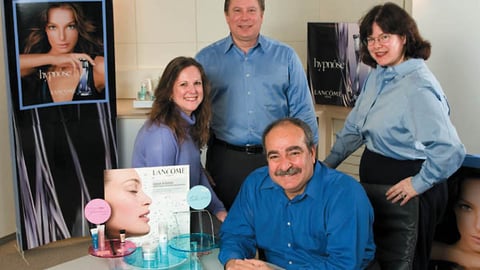
Joe DeLise III, vice president of promotional purchasing at Lancome USA, calls himself the "Geek of the Floor" because he's the techie his coworkers seek out when they have computer problems. Though he is a self-proclaimed aberration in the makeup world, DeLise's seat at Lancome is the result of his long career as an executive for beauty's biggest names.

In addition to knowing his way around a microchip, this gentle giant of cosmetics P-O-P has an old-fashioned, do-it-yourself sensibility and mechanical curiosity that he swears is what keeps his ideas fresh in the industry. P-O-P Times' Julia Steinberger sat down with DeLise, one of three 2006 P-O-P Hall of Fame inductees. Q&As with Dina Howell, Procter & Gamble Co., and Leslie Nagy, Pepsi-Cola Co., will appear in following issues.

How did you get started in P-O-P?
I'm not your typical cosmetics guy. I'm also not your typical corporate guy. My father-in-law, who recently passed away, owned a printing company and my father was a bookbinder, so my father was a supplier to my father-in-law. I knew the printing business, because my father used to drag me into the shop on many weekends.

One day while I was working for a printing company, I got a phone call from Coty Inc. I had just turned 25, and five interviews later I got the job. I started with buying commercial print and printed packaging. I had a great mentor at Elizabeth Arden, Mike Lombardi, who said "You seem to be mechanically inclined; do you want to get involved with package development and displays?" This was back in 1990, so he gave me the responsibility of point-of-purchase materials, promotional package development, imports, pretty much everything but chemicals. And I remember his words, "And don't come complaining to me, either."

What exactly is your team responsibility, and how do you work with marketing at Lancome?
The involvement of myself and my team is basically taking the drawings and ideas of the creative department and turning that into a manufacturable reality. We have approximately 29 people involved in creative who work closely with marketing. My team has been presented with anything from a cocktail napkin with drawings on it to Adobe Illustrator drawings, seldom provided to true scale.

Have you and your team created a display that you are particularly proud of?
My team is an experienced backbone and significant part of the success of Lancome. The purchasing team consisting of Susan Gardiner, assistant vice president promotional purchasing; Debra Presbrey, purchasing manager; Mike Grieco, purchasing consultant; Laura Lipawsky, purchasing coordinator; and Carmen Gonidakis, purchasing administrator, supports more than 80 marketing, creative and other professionals.

A nod of approval from experienced and talented industry veterans like Nina White, senior vice president of marketing/deputy general manager of Lancome and Doug Huffmeyer, vice president creative services, and their teams is, to quote MasterCard, "priceless." So to me, there is no single display that comes to mind for bragging rights. There are never two displays or promotions alike, they are all high-end P-O-P materials produced under demanding internal and external conditions, which must satisfy the ultimate retailer and consumer's needs, which makes me most proud and particularly proud of my team!

What are the greatest challenges involved in creating P-O-P?
Recruiting and retaining truly experienced talent is the current challenge -- on both sides of the desk. The consolidation of retailers, marketers and display manufacturers has shrunken the talent pool. Additionally, I feel that due to the financially driven "headcount" scenarios that corporate America's accountants have generated, there are no longer people employed as understudies/junior execs for proper in-depth training and departmental succession planning.

I am truly concerned that the next group of P-O-P-related staffing will be much more computer-oriented and working without the hands-on, old-fashioned '90s knowledge of how to accomplish tasks presented to them.

Another challenge is creating P-O-P with better marketing/planning for re-use. Modularity engineering, with an eye toward recycling.

What are your thoughts on the rise of mass cosmetics and knockoffs?
I unfortunately think it's part of our future. With the price of some luxury products now equaling the cost of round-trip airfare or weekly groceries, it makes you wonder if some consumer thinks, 'Am I going to spend almost $100 + on a cream (I hope so!), or should I go away for the weekend, or do I buy a new DVD player?' So we have to be careful with our pricing, because not only are we competing with the Estee Lauders, Cliniques and Clarins of the world; we're also competing with other lifestyle products [like consumer electronics] that have a longer-lasting value and that can benefit more people within a family.

As L'Oreal USA Supplier Diversity Council Director, you help ensure that your company does business with supplier companies owned and managed by women and minorities. How do you do this?
Edward Bullock, vice president of corporate diversity, asked me to head up the Supplier Diversity Council. I went to my peers in all the divisions within the company, in Maybelline, L'Oreal Professional, L'Oreal, Redken, Kerastase and others, sat down with them and said, 'Here's a list of suppliers who fit the diversity requirements, who have the right qualifications and certification.'

As a result, we've increased our diversity spend, and our chairman was honored with a diversity award in October 2004. The face of America is changing, and we have to be cognizant of it. One of the hardest parts, though, is that in the 26 years that I've been doing this, I've dealt with very few minority people. There's just not that many in the cosmetic packaging and point-of-sale business. I feel it's an obvious opportunity for the truly qualified.

Throughout your career, you've always been a go-to person with computers. Does that continue at Lancome?
I'm definitely the geek of the floor. I've always been interested in electronics and communications and how things worked, to the point where my dad kicked my butt one day because we had an antique pinball machine in our basement, built in the '30s, and one rainy Saturday, when I was about 11, I took it apart. It never went back together.

So, as resident geek, what do you think about RFID? Do you think it applies to class cosmetics?
No, I don't see it happening for that, and as long as our sales staff is doing their job, we should never need it. Part of this brand is the personal touch, the extra attention. The beauty advisor advises, she's not there just to pitch.

It's probably going to come one day, because it does reduce cost on the whole internal distribution side of things. I just hope there's always a beauty advisor there to help you. I'm also the type of person who wants as many people employed as possible. The more people that are employed, the more money's coming in to people that can go out and buy the products that we're trying to push. And I think a lot of companies forget that.

What do you do on Lancome's Corporate Graphic Arts Team?
The company realized that each of its different brands was operating as an independent fiefdom, and that there were definitely a lot of synergies, and cost-saving potential, if we just did things a little bit more collectively.

Several years ago, we were sitting in a meeting with a group of purchasing people from different brands, and I looked around, and noticed that everybody in this particular group buys printing, and I said to myself, 'Everybody's using different suppliers, everybody has different needs, their timing is different, they're producing different things.' But the one thing they did have in common was paper. So I crossed what I call 'state lines.' I got permission to go speak to people at other brands and put together a paper program, which enabled the company to purchase certain types of paper at a reduced cost, and we have a little bit more leverage and relationships with some of the paper mills. I think as a result, the company saw that if we do more and more things together, we can save a few bucks along the way.

How do you work with suppliers to keep costs down?
Most buyers that I've come across over the years know things peripherally. They may know how to purchase something but not how it's made. They may not know that if I can reduce the gauge on something by a certain amount, I can go from a thousand-ton machine to a 750-ton injection-molding machine, and I can be more competitive at getting this particular thing within budget. Once people know how things are made, and that most of the machinery is fairly standardized, they can start designing things to fit efficiently.

How have you gone about teaching the people that you work with to look at things more mechanically?
My door's open. And if I walk by and see a supplier sitting in someone's office, I'll go in and schmooze a little bit, and ask, 'Do you have that prototype ready yet? Let me play with it a second.'

One of my many nicknames around here is the 'Samsonite Gorilla.' I'll take things and I'll play with them, and I'll ask, 'Why are you making it this way? If you make it that way, then it's easier to assemble on line. You don't have to build a set of jigs to glue this thing, and we'll have a more consistent, better part, that's easier to make, and it'll be less expensive.' Most of the suppliers that I work with love it.

How are new materials and processes changing the design and longevity of P-O-P?
Being an Italian-American who believes displays should be built as strong as brick outhouses, I'm very excited about new materials frequently arriving on the market. Some problems I see are:

A) Designing to a new material's cost and availability, particularly when smaller quantities needed to be manufactured.

B) Too frequently, the supplier community is not as open to the unknown. I believe a portion of any P-O-P manufacturer's operating budget should be dedicated to R&D of new materials, adhesives and assembly techniques.

How do you feel about touchscreens and digital P-O-P?
Well, it's something that I'm working on kind of on the hush. It's not exactly a touchscreen, but it's close. It's potentially for some smaller stores, for the self-service areas for some stores, and that's about all I can say about it at the moment.

Do you think it can inform and retain customers as well as a live sales staff?
No. But it can do it in many languages, and it can do it when someone doesn't want to wait for the sales staff to be done with the two people in line ahead. It can also register purchases real quick. I think it can just provide some information. I'd like to have it Internet-enabled in a couple spots, so you can see what's moving instantly.

You keep a set of Legos on your desk. Why?
Legos remind me, and the people I work with, of the importance of ease of assembly. I have to make things so that when they get on-counter, the people behind the counter have minimal work. The Lego is also for the suppliers, because when they make things, it has to be simple, too.

How do you find new materials?
I'm one of those guys who will walk around at Home Depot, I'll walk around a car showroom, I'll go to unusual trade shows, and I'll see things that normal display people would never look for.

A lot of display companies, and this is one of my critiques; they're very set in their ways. When I used to own a car, I owned a Lexus, and one of the first things I did was take it apart. 'How did they put this together? What material is this? How did they fasten this?' I look for inspiration in ideas and materials. 'What is this? How did they get this type of finish and color match on this?' Granted, they're making 50,000 of these cars, not 2,000, but if they can do that, so can I.

What cultural changes affect your company's use of P-O-P?
The financially driven retail consolidations in the department store retail channel will most likely create a more formidable voice in our design and P-O-S appearance.

The other key for all of us to keep an eye on is the growing size and importance of American diversity. Every market opportunity must be embraced, even if it means more customization such as bilingual displays, smaller quantities or special logistical requirements.

By the way, from someone who was conceived at the tail end of the baby boom, those designing displays and P-O-S materials had better consider diminishing eyesight, poorer hearing and challenges bending over to reach the lower shelf. These are aspects which seem to me to be frequently ignored.

What's best about your job?
Now that my wife of 27+ years, Hillary and I are "empty nesters" and have moved back to Manhattan, I joke that the best part of my job is the ability to walk to work. But seriously, this career has introduced me to numerous wonderfully talented, creative and dedicated people at many companies. It provided me the chance to travel to more than a dozen countries and throughout the United States, and also the opportunity to create something that's never been done, on practically a weekly basis. Working for a world-class, quality-oriented company with a name recognition and consumer product quality appreciation like Lancome cannot be topped by any other consumer product P-O-P career position.

X
This ad will auto-close in 10 seconds