Creative Is the Missing Link in Retail Media's Next Phase

Retail media has become increasingly more effective in delivering scale and performance, but it’s time to unlock more value through high impact creative that captures attention where it matters most.
Walking around Shoptalk this year, one thing stood out across brands, agencies and retail media teams: Access is no longer the issue. Networks are built, inventory is everywhere, and targeting is increasingly standardized, with the key differentiation being the retailer’s first-party data. The real challenge is making it actionable and leveling up what audiences are actually seeing from a creative perspective.
Retail Media Is Expanding Beyond Owned Channels
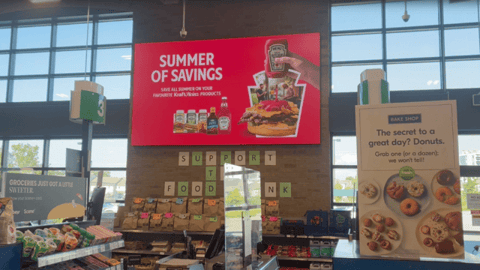
Retail media is no longer confined to owned and operated or in-store environments. Brands are extending these strategies offsite, particularly into digital out-of-home (DOOH) placements near and inside stores, finding audiences at crucial decision-making moments.
Reaching consumers close to the point of purchase allows brands to engage in moments directly tied to conversion. DOOH extends retail media into those moments in a way that is both contextual and measurable.
With a greater desire to scale, marketers are moving beyond single retailer activations and looking to reach consumers across multiple environments where they can influence action. The goal is a consistent presence in high-intent moments.
However, extending retail media offsite only works if the experience feels connected, not fragmented. That requires cohesive messaging across channels.
From Exposure to Action, Creative Is Driving the Difference
DOOH has historically been viewed as an awareness channel, but that's starting to shift. Brands are thinking more about what happens after exposure. DOOH can influence conversion at the point of purchase, and when connected to mobile retargeting with coordinated messaging, it becomes measurable and tied to outcomes.
DOOH into mobile retargeting allows brands to move from showing up in the right place to influencing behavior after that initial exposure. As expectations rise, marketers are no longer choosing between awareness and outcomes. They expect both.
The problem occurs when offsite solutions all look the same. Inventory, targeting and pricing are no longer differentiators, they are table stakes. As a result, performance is beginning to converge. The difference is what is being seen and how it resonates with consumers.
Marketers are placing more emphasis on storytelling. Instead of one-off impressions, there is a shift toward sequenced communication. DOOH introduces the idea, mobile continues the conversation, and creative is what ultimately sticks.
Learn More in person
Big Happy's Neil Ford will discuss the future of contextual commerce on a panel that includes DoorDash and Roku.
The panel will be held June 4 in Chicago at Retail Media Summit.
For details, visit p2piretailmediasummit.com
Creative is the true growth lever. It is not just about driving short-term conversion, it is increasingly tied to long-term value and repeat behavior. The brands seeing the strongest results are testing and iterating more frequently, treating creative as something that evolves in-market rather than a fixed asset.
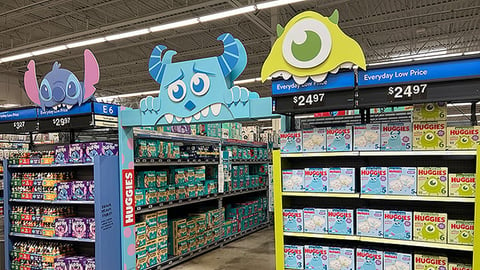
Strong, visually dynamic creative consistently outperforms standard formats in attention, recall and engagement, especially in environments where consumers are moving quickly.
What is emerging is a more connected model, where creative is not layered on top of media, but built into how the system works. When creative, placement and follow-up messaging are aligned, the result is a more cohesive experience that drives both immediate action and long-term impact.
Retail media is entering a new phase. The focus is shifting from access to impact. Expanding beyond owned environments, connecting physical and digital, and aligning creative with performance are becoming requirements.
The next phase won't be defined by who has the most scale or the largest number of households. It will be defined by who can turn that inventory and targeting into something consumers notice, remember and act on, while also being additive to the strong solutions RMNs already provide.
About the Author
Gabby Stoller is CRO at Big Happy and a seasoned sales and media executive with experience spanning startups and major companies. She previously led omnichannel strategy at Walmart Connect, working with top global brands, and has held roles at The New York Times, Verve, Placed and Vistar, with a focus on scaling teams and driving growth.