
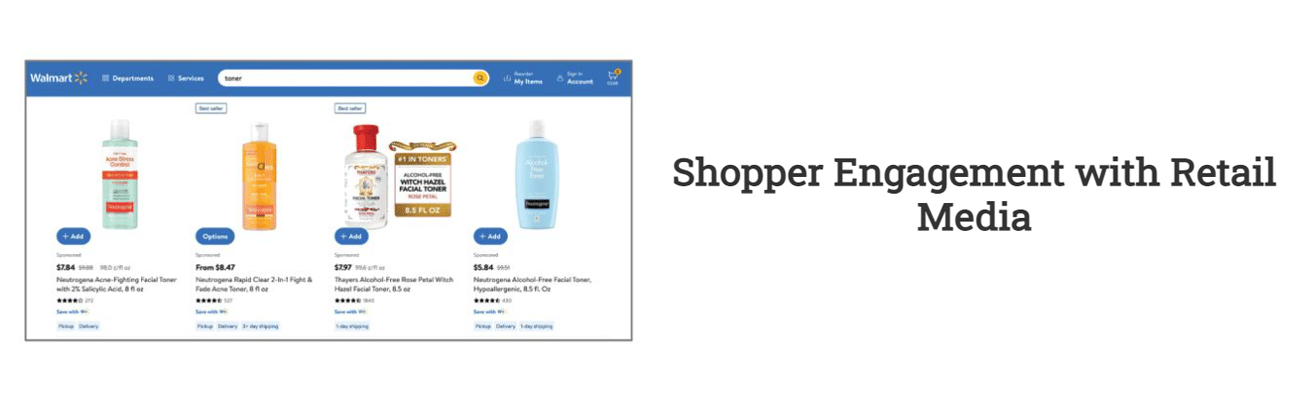
Retail Media Insights from Consumers and Shoppers


Retail media might just be the hottest topic in the world of commerce marketing — and it’s showing no signs of slowing down. But what do consumers think about retail media, and how are they actually interacting with it across platforms? On the following pages, we invite you to dig into retail media from the shopper’s viewpoint. (Hint: promotion/sale messaging still reigns supreme!)
Research from the Path to Purchase Institute earlier this year focused on the state of retail media from the industry’s perspective — that of CPG and durable goods professionals. But what about retail media insights from the consumers, or shoppers?
While average consumers likely have little or no knowledge about the term “retail media,” they are exposed to it often. And their opinions on their exposure to retail media’s tactics could be a gold mine for those same industry professionals we heard from in our May survey (reported in our July/August issue).
Before we fielded our survey of consumers in July, we had to first identify retail media’s primary touchpoints. To get there, we looked at the published/known tactics of established retailer media networks (including Walmart Connect, Target’s Roundel and Kroger Precision Marketing) and devised general questions about retailers’ in-store, online, email and social media engagement with consumers, as well as the relevant activity that occurs on third-party media sellers’ websites.
We surveyed 1,000 self-identified shoppers who shop in-store and/or online at least once per month at one of the 25-plus retailers we named who operate their own media networks. Respondents’ shopping activity broke down like this:
• 74% shop both in-store and online.
• 22% shop in-store only.
• 3% shop online only.
We asked them to identify which retailers they shopped, with Amazon (76%), Walmart (72%), Dollar General (60%), Target (51%), CVS (48%), Walgreens (47%), Kroger (42%) and Family Dollar (41%) being cited most often.


In-Store Retail Media
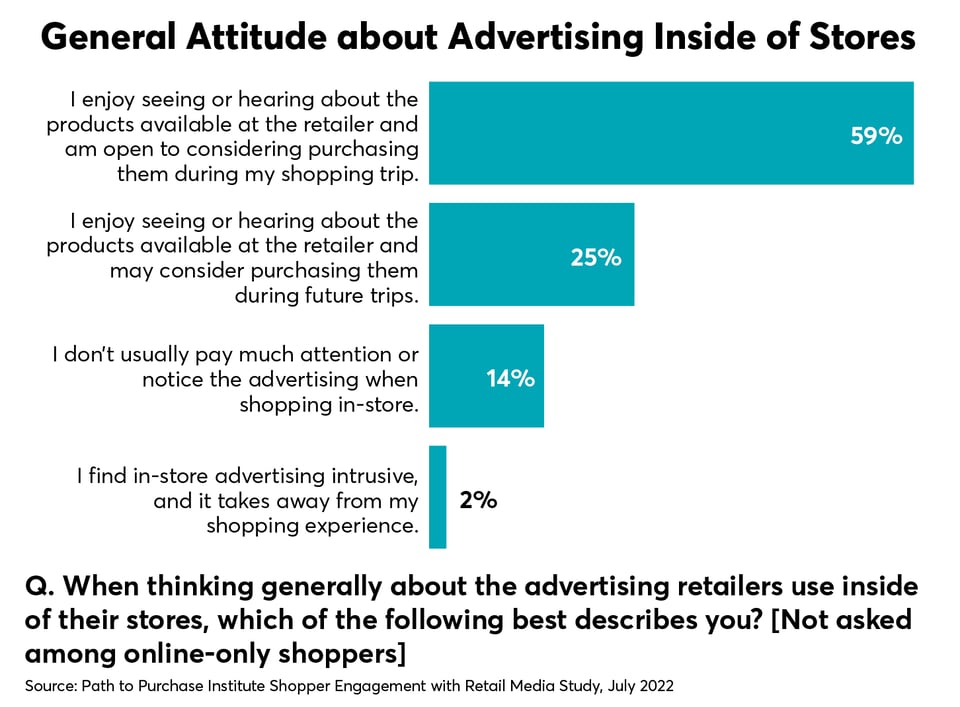
To start, we investigated the advertising that retailers use inside of their stores. Eighty-four percent of respondents said they enjoy seeing or hearing about available products while shopping in-store — and 59% not only said they enjoy it, but that they are also open to purchasing the items advertised. Meanwhile, 14% said they don’t pay attention to that advertising, and just 2% said they find in-store advertising intrusive.
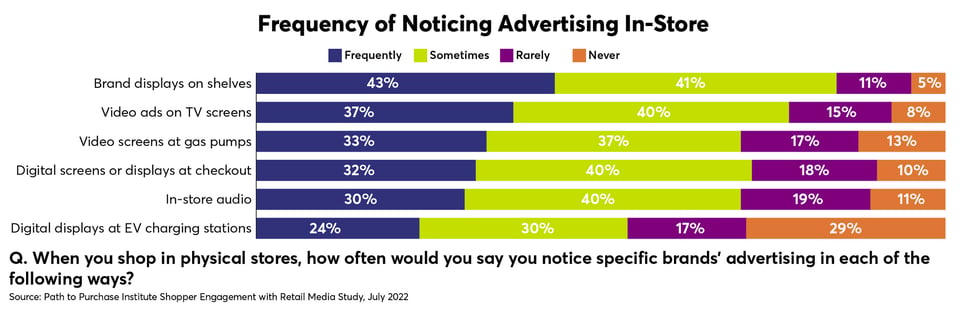
We next asked how often they notice specific types of brand advertising in stores: 84% of respondents said they frequently or sometimes notice brand displays on shelves. Furthermore, at least 70% of respondents said they frequently or sometimes notice video ads on TV screens, video screens at gas pumps, digital screens or displays at checkout, and in-store audio. Among our choices, only digital displays at electric vehicle charging stations came in below 60% (likely impacted by the lack of these types of locations to begin with).
Breaking things down further, for those who indicated they enjoy seeing or hearing advertising in-store, 47% said they “frequently notice” brand displays on shelves — significantly higher than for those who said they don’t pay attention or find ads intrusive, which came in at 21% for noticing brand displays on shelves. Those two groups also noticed in-store audio at much different rates: 34% for ad lovers compared to 13% for the ad-adverse/aloof.
Next, we zeroed in on those who said they notice a particular tactic in stores, asking them if they believe seeing or hearing those advertisements encourages them to locate a product in the store, to find the product online and consider purchasing, or to briefly consider but take no further action.
There were similar results across the board:
• 68% (video screens at gas pumps) to 81% (brand displays on shelves) said they frequently or sometimes locate the product in-store and consider purchasing.
• 63% (video screens at gas pumps) to 76% (digital screens at checkout, and digital displays at EV charging stations) said they frequently or sometimes find the product online and consider purchasing.
• 72% (video ads on TV screens) to 76% (brand displays on shelves) said they frequently or sometimes briefly consider but take no further action.
We then asked what aspect of brands’ in-store advertising most catches their attention or makes them want to learn more about the product. “Tells me about a promotion or sale” topped the list at 32%, followed by “Advertisement is unique or eye-catching” (22%), “Introduces me to a new or unique product” (21%) and “Reminds me about a product I needed to buy” (19%). Other responses finished close behind.
To understand how online exposure to ads affects their in-store shopping, we asked if they ever notice a brand’s advertising in-store after previously encountering an ad for that brand online. The “frequently” (28%) and “sometimes” (50%) answers outpaced “rarely” (16%) and “never” (6%).
Furthermore, we asked what about that ad catches their attention for a second time. The top responses were: “Tells me about a promotion or sale for that item” (31%) and “Advertisement is unique or eye-catching” (28%).
Looking at things differently, we asked how often they seek out brands in-store after seeing their ads online. “All of the time” (21%), “most of the time” (29%) and “some of the time” (34%) garnered the most responses — a combined 84% of our survey takers.


Online Retail Media
Changing the focus to retailers’ online activity, we asked respondents why they typically visit retailers’ websites or mobile apps. Looking for promotions, deals or coupons (48%), comparing prices with other retailers (45%) and browsing products and finding inspiration (42%) garnered the most responses, followed by repurchasing items they buy regularly (39%) and purchasing new items or items they don’t buy regularly (37%).
Respondents then had to choose the best description of how they shop on retailers’ websites or apps. “I usually know exactly what I’m looking for and navigate there right away” (48%) and “Sometimes I know exactly what I’m looking for, but other times I am there just to browse” (44%) far outpaced “I am often just browsing” (8%) as the top choices.
When asked how often they notice brand advertising on retailers’ websites or apps, 88% of respondents answered “frequently” or “sometimes.” Just 11% said “rarely” or “never.”
Survey responses indicated a significant opportunity to increase relevance and engagement, as 69% of respondents at least partially agreed that they rarely click on or engage with online ads, and 66% said they feel like most online ads are not relevant to them.
The same question positively showed that 77% at least partially agreed that they enjoy when retailers show they know shoppers by advertising products that they have purchased or considered purchasing. Additionally:
• 77% at least partially agreed that they have made purchases based on seeing an ad on a retailer’s website or app.
• 81% at least partially agreed that they are often reminded of products that they have considered in online advertising.
• 80% at least partially agreed that they like when retailers suggest new products that they haven’t heard of before.
We showed survey takers separate images of brand display ads and then paid search ads from retailer websites before asking how often they noticed ads like that and have they ever clicked on them. Results showed:
With brand display ads, 83% said they at least sometimes notice ads like that, and 60% said they at least occasionally click on those ads.
With paid search ads, 90% said they at least sometimes notice ads like that, and 73% said they at least occasionally click on those ads.
For both types of on-platform ads, we asked what captures our respondents’ attention or makes them want to click on the ads. “Offers a discount or promotion” (31%), “Is something I want or need to purchase” (28%), “Is a product I was already searching for (26%) and “Eye-catching image or video” were all selected by at least one-fourth of respondents.
Among only the respondents who previously said they “rarely” or “never” click on such ads, 39% said “Offers a discount or promotion” captures their attention and would make them want to click on the ads.
When we asked how often these online ads encourage them to purchase the product, 27% said “frequently” and 55% said “sometimes,” while 19% answered “rarely or never.”
To understand their attitudes toward off-platform advertising, we showed an example of a brand’s digital ad on a news website promoting its availability at a specific retailer, and 71% said they frequently or sometimes notice ads like that. Furthermore, 70% said they frequently or sometimes pay attention to or engage with these ads.
Like with retailers’ onsite ads, these offsite ads do capture attention when they offer a discount or promotion (indicated by 31% of respondents). Other top responses included, “Is a brand I know and trust” (27%) and “Is a retailer I know and trust” (23%).


Retailer Email
To get an understanding of how consumers react to retailers’ emails, we first asked if our survey takers had digital accounts with the retailers we identified, were members of their loyalty programs, or opted in to receive their emails. More than half said yes for Amazon, while at least 25% said yes separately for Walmart, Target, Kroger, Walgreens and CVS.
We then asked what they want retailers to include in those emails — what most catches their attention or makes them want to learn more. Similar to the opinions they gave for in-store as well as online advertising, respondents selected “promotions, sales or coupons” (45%) more often than any other option. “Personalized offers” was next with 30%. Far down the list was “user-generated content or reviews,” which was selected by just 13% of respondents.
When asked how often they take certain actions after seeing a brand’s product being advertised in retailers’ emails:
• 74% of respondents said they click on the product to learn more at least some of the time.
• 71% said they at least sometimes purchase the product being advertised the next time they are in the store.
• 71% said they at least sometimes purchase online the product being advertised.


Social Media
To get an understanding of how consumers react to retailers’ social media activity, we first asked our survey takers if they follow any of the retailers they shop on social media. Thirty-seven percent said yes for Amazon. Beyond that, those named most often were Walmart (27%), Target (23%), Dollar General (16%), Kroger (15%) and CVS (14%).
We then asked how often the content they see from retailers on social media influences them to shop for or purchase certain products. Eighty-six percent said it at least sometimes does, while 14% said it rarely or never does.
We then presented six different types of social media postings and asked how likely our respondents were to want to learn more about a product available at a retailer after hearing about it in those ways. Approximately 80%-90% said they were at least somewhat likely to want to learn more for every way we presented. “Recommended for you” pages and posts from either brands or retailers were most influential.


Third-Party Media
Since ads that appear off of retailer sites (i.e., on third-party sites) are often an integral part of retailer networks, we wanted to understand if consumers view or engage with these ads differently than those on retailer sites.
We started by establishing how often our respondents actually visit or use specific third-party sites. Respondents said they visit Google or YouTube (each have more than 80% visiting at least once per week), as well as Facebook, Instagram, TikTok and Hulu (each have at least 70% visiting that much).
We asked how often respondents click on ads to learn more about a product when using a specific third-party website/app, and 50% said they click at least most of the time when on TikTok, Instagram, Facebook and YouTube — while the others we named all received 40%-50% for most or all of the time.
Finally, and to no surprise, when we asked what about these ads on third-party sites/apps captures their attention and makes them want to click to learn more: “Offers a discount or promotion” (35%) was the clear leader among the responses we offered.
