Walmart, Kroger, Home Depot, Others Accelerate Agentic AI Deployments

As the National Retail Federation (NRF) Big Show 2026 kicked off, a wave of retailers announced the deployment of agentic artificial intelligence solutions — moving beyond chatbots and toward autonomous systems capable of executing complex commerce tasks across the shopper journey.
At the center of the news is Gemini Enterprise for Customer Experience (CX), Google Cloud’s new agentic solution designed to unify shopping and service into a single, continuous experience. Rather than responding to isolated prompts, the platform enables retailers to deploy AI agents that maintain context across touchpoints — from product discovery and cart-building to fulfillment and post-purchase support.
The shift marks a new phase of retail transformation, where AI moves from assistive to action-oriented, connecting channels and reducing friction across the entire path to purchase.
Major Retailers Deploy 'Digital Brains'
Several retailers showcased how they are integrating these autonomous agents into their core operations to simplify consumer decision-making:
Kroger
Kroger unveiled an expanded relationship with Google Cloud and will roll out Gemini Enterprise for CX nationwide to help make grocery planning easier and faster through an integrated meal assistant and shopping assistant.
The goal is to transform meal planning into an “inspiration-to-cart” flow, converting a customer request such as “I want to prepare vegan tomato soup” into a guided recipe with a detailed ingredient list that can be added to the cart with a single click. The agent can build a full weekly basket based on dietary preferences, budget and local store availability in seconds.
Beyond the customer-facing experience, Kroger is also using Google’s Customer Experience Agent Studio to analyze inbound calls to stores, identify recurring pain points and resolve issues earlier. The goal is a more seamless, “white-glove” experience that improves associate productivity while reducing friction across digital and physical touchpoints.
The Home Depot
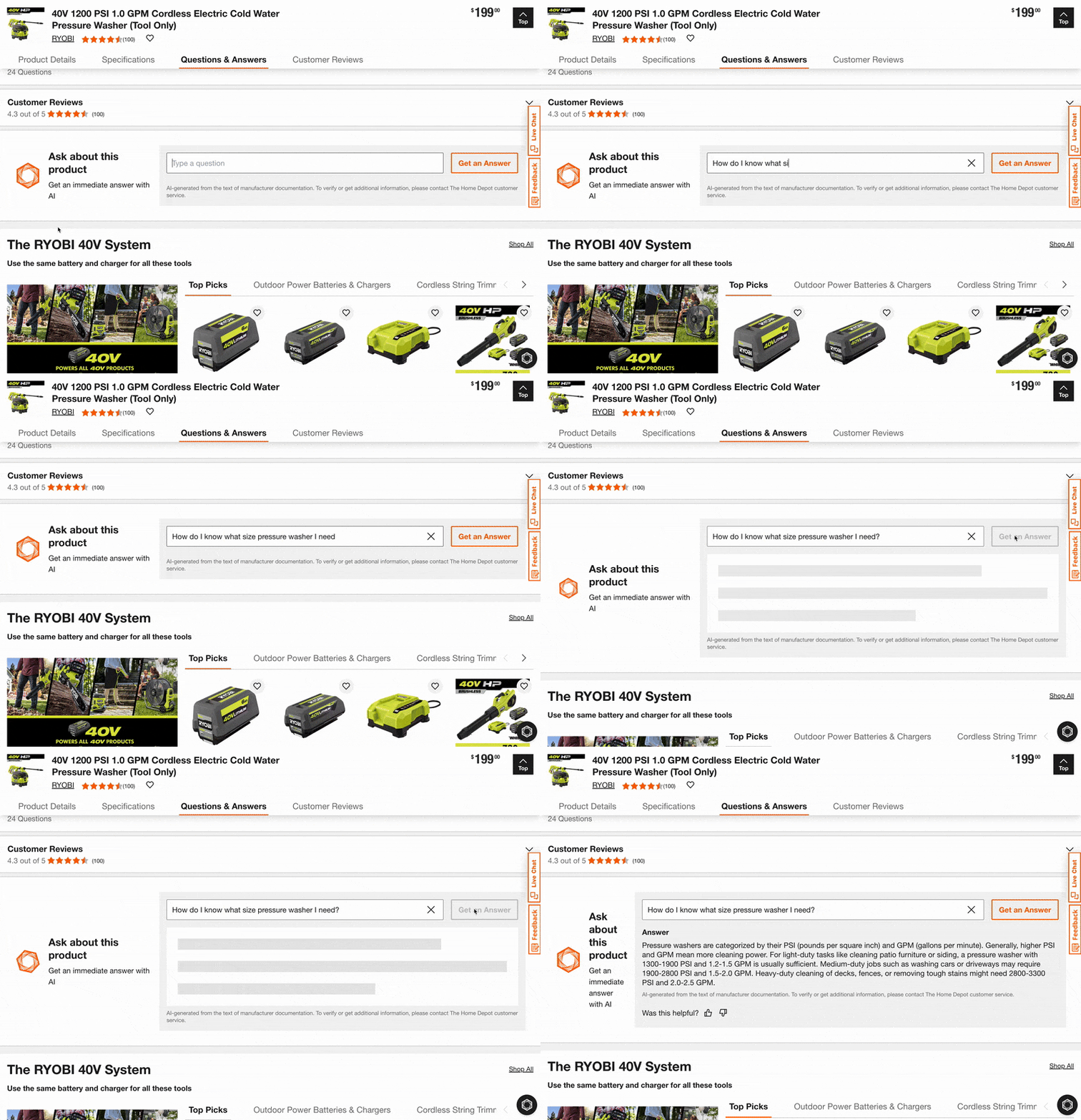
The Home Depot is expanding its "Magic Apron" suite of tools and integrating Gemini models to provide aisle-level precision for DIYers.
What began as a digital assistant on product pages is evolving into a conversational, multimodal companion that supports shoppers wherever they are — at home, on a job site or in the aisle. Shoppers can describe projects in plain language, upload images or ask technical questions, and Magic Apron responds with tailored guidance, product recommendations and, notably, aisle-level wayfinding tied to local store inventory.
In-store, the localized AI experience directs shoppers exactly to a product while suggesting complementary items — blending digital intelligence with physical navigation. For pro contractors, the tools can translate project descriptions into complete materials lists.
Behind the scenes, The Home Depot is also deploying Gemini Enterprise to automate workflows for associates at its Store Support Center, freeing teams to focus on higher-value strategy and problem-solving.
Walmart
Walmart’s announcements point to how agentic AI is beginning to reshape product discovery itself.
Through an expanded partnership with Google, Walmart will integrate its massive assortment, pricing and fulfillment capabilities directly into the Gemini app using Google’s new Universal Commerce Protocol (UCP) — an open standard co-developed with retailers including Target, Etsy, Shopify and Wayfair.
The experience allows shoppers to move from inspiration to purchase within AI-driven conversations, with Walmart products automatically surfaced when relevant. When shoppers link their accounts, the experience becomes personalized, drawing on past online and in-store purchases, loyalty benefits and fast local fulfillment options. The experience will first launch directly within Gemini in the U.S. and internationally thereafter.
For retailers, the move underscores a growing imperative: being present and actionable at the moment of AI-led discovery, not just within owned apps and websites.
In related news, Walmart also expanded its partnership with Google Wing to bring residential drone delivery to more than 40 million Americans.
Additional Cloud Customer News:
- Lowe’s is enhancing its "Mylow" assistant to provide project guidance tailored to a customer's specific home and local climate, moving from product suggestions to active problem solving.
- Authentic Brands Group is launching “Authentic Intelligence,” an AI toolbox of over 15 specialized agents, enabling brands like Reebok to generate high-quality marketing assets in minutes rather than months, resulting in a 40% higher return on ad spend.
- Honeywell is collaborating with Google Cloud and 66degrees to launch The Smart Shopping Platform – an "out-of-the-box" AI solution that brings the power of digital commerce directly into the physical aisle.
A New Standard for Agentic Commerce
Beyond individual implementations, Google’s launch of the UCP signals a broader industry shift. Google said the open standard is designed to create a common language that allows AI agents, commerce systems and payment providers to work together across platforms.
Early applications include:
- A checkout feature that will soon enable purchases directly within AI mode in search or the Gemini app.
- Business Agents that let shoppers chat directly with brands on search. Brands can answer product questions in their voice and connect with consumers during high-intent moments.
- New ad formats, including “Direct Offers,” a Google Ads pilot that allows advertisers to present exclusive offers for shoppers who are ready to buy – directly in AI mode.
For retailers and brands, these developments raise new questions about visibility, control and differentiation as AI increasingly mediates discovery and decision-making, and as commerce shifts toward agent-driven interactions that operate beyond traditional digital storefronts.