Retail Automation Report: Store-Wide Solutions

Retail automation is having an ever-bigger impact on grocers and their customers, who are seeing more of it in their everyday shopping, and it will continue enhancing consumer experiences in ways that are visible and ways that aren’t.
Whole Foods Market is a case in point. Its parent company, Seattle-based Amazon, is rolling out a new generation of its scan-and-pay-as-you-go Dash Carts at select Whole Foods stores. An earlier generation had been in use at the soon-to-be shuttered Amazon Fresh chain, giving shoppers an alternative to more traditional and Just Walk Out checkout options. The latest Dash Carts incorporate features designed to make using the onboard interface easier and more attractive for shoppers.
An Amazon representative points to a company assessment of how the latest Dash Cart can improve the shopping experience, with, for one thing, a new built-in screen that displays prices and also maintains a running total as customers shop, helping them stick to budgets. It also features Alexa shopping list integration so shoppers can easily add items to their shopping lists at home or on the go. This Dash Cart can help customers navigate the store, by referencing an interactive map, and get personalized deals on nearby products as they move around the sales floor.
The redesigned Dash Cart scanner is more responsive and prominently positioned right next to the screen, Amazon notes, making it easier and faster for shoppers to add items to their carts. A built-in scale allows shoppers to weigh fruits and vegetables as they go. The basket on the latest Dash Cart model is 40% larger but 25% lighter, making big shopping trips easier. When they’re finished, shoppers can simply roll through a designated Dash Cart lane that automatically processes payments.
At Work
When grocers consider retail automation, the focus may be what it can do, but Marshal Cohen, chief retail industry advisor at Chicago-based market research firm Circana, says that their technology’s efficacy is already evident in the market.
“So far, it has shown up as a cost benefit with less out-of-stocks and less commitment to product projections that are over- or underestimates,” Cohen notes. “Running more efficient inventory can grow revenue by 2% to 3%. Minimizing shrink through automated checkout can help the bottom line by up to 4% to 5%.”
Scott Benedict, founder and CEO of Bentonville, Arkansas-based consultancy Benedict Enterprises and a former Walmart buyer, has witnessed retail automation’s advance. According to Benedict, as it has become integrated into operations, retail automation has helped retailers restructure and upgrade their business processes, including in the development of unified-commerce operational structures.
“I do think we’ve crossed an important tipping point where retail automation is no longer primarily about labor substitution or novelty, but about operating viability in an environment of sustained margin pressure, rising service expectations and channel complexity,” he says.
“What we’re seeing now is a shift from point solutions to connected systems, whether that’s ESLs tied to pricing and promotions, RFID feeding real-time inventory accuracy, computer vision supporting on-shelf availability, or smart carts integrating basket building and media," he adds. "The strategic value comes from how these tools work together to support unified commerce.”

On the Shelf
Electronic shelf labels (ESLs) are becoming a bigger part of retail automation.
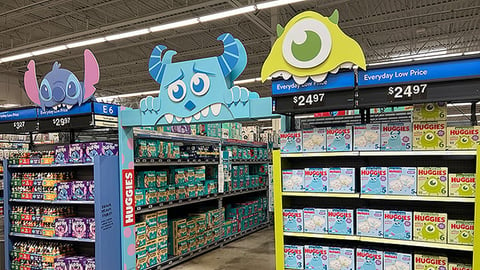
For instance, Bentonville-based Walmart has been rolling out ESLs in stores. A company representative explains that the ESL introduction began in 2024, adding that Walmart anticipates their reaching “all stores in the next 12 months.”
Walmart is using ESLs and other retail automation to simplify work for associates and create more consistent experiences for customers. The innovation reduces manual work for workers, “enabling more time to be spent serving customers,” the representative notes.
At a Grapevine, Texas, Walmart supercenter, which the company renovated to install and test new features and capabilities, Walmart trialed its ESLs. In a blog post, Daniela Boscan, then food and consumable team lead for the store, characterized the automated devices as shifting how employees “manage pricing, inventory, order fulfillment and customer interactions, ensuring our customers enjoy an even better shopping experience.”
The ESLs free employees to help shoppers, as associates can update prices through a mobile app rather than walk the store changing paper tags.
“Retail automation is shifting toward labor efficiency and better utilizing the data retailers have,” says Patrick Henseler, marketing manager, retail services at Bridgeton, Mo.-based Hussmann Corp., a leading global manufacturer of commercial refrigeration equipment. “Hussmann is focused on ESLs for promotion execution and pricing integrity, plug‑and‑play case‑temperature monitoring for food safety, and predictive maintenance solutions that connect equipment performance to actionable insights from StoreConnect,” a cloud-based platform that continuously monitors refrigeration systems for leaks.
Among the advantages of ESLs, Henseler notes, is that they “eliminate thousands of manual price changes weekly, allowing associates to focus on customers and higher-value tasks while prioritizing price accuracy.”
Further, he observes: “Automated case‑temperature monitoring removes manual checks — and logging/auditing — saving labor while improving compliance. StoreConnect reduces emergency service calls, giving teams back time previously spent handling equipment issues or de-merchandising cases.”
Reducing Friction
With customer-facing retail technology, consumers have become more accepting of automation, especially in those cases where it reduces friction, says Cristina Rodrigues, VP marketing, Americas for Nanterre, France-based Vusion, a management platform for ESLs and other Internet of Things (IoT) devices.
“In recent surveys, a strong majority of consumers say they actively use, or are interested in using, in‑store automation and are comfortable with automated checkouts when they deliver faster, more convenient trips,” Rodrigues observes. “Adoption of self-checkout has reached ‘mature’ levels for many retailers, and shoppers increasingly expect options like scan and go, click‑and‑collect pickup, and digital shelf information, rather than seeing them as novelties.
"Retail automation is evolving from back‑office optimization to real-time orchestration of the full in‑store journey," she continues. "Electronic shelf labels, computer vision and connected sensors now link every product and price to the cloud, so shelves, apps and media all reflect the same live data. This shift is turning physical stores into responsive, data‑driven environments.”

The Modular Approach
Retail automation is also making a significant difference in supply chain operations. Derek Rickard, director of sales at Cimcorp North America, a systems integrator and manufacturer of robotic material-handling systems, says that with experience, retailers have become deliberately strategic in their approach to automation.
“They’re exploring solutions that can keep costs down while generating the strongest ROI,” Rickard notes, “and while they want to solve current challenges, they don’t want to get locked into a static system that can’t keep up with evolving demands down the road. With these requirements in mind, many companies are adopting modular automation. Modular solutions are made up of standardized, pre-engineered cells of automation, essentially automation building blocks. These building blocks can be configured and quickly integrated into virtually any facility layout, and retailers can start by automating areas where they’ll see the biggest impact.
"Fresh food handling is a great example. In many DCs, fresh produce-handling operations are still largely manual. It’s cumbersome, physically demanding work, and it’s difficult to keep these areas staffed," he continues. "Plus any mistakes or delays can lead to premature spoilage and waste. By automating these processes, retailers can ease labor demands, move fresh products faster through the facility and minimize losses from spoiled inventory.”
Store of the Future
According to Amit Acharya, head of product – retail at Atlanta-based NCR Voyix, store operations now benefit “from edge-enabled agility and unified systems that improve accuracy and reduce manual effort across channels. Automated signals and intelligent sensing technologies enhance inventory reliability and streamline checkout by reducing errors and repetitive tasks.
"Digital pricing solutions allow enterprise-wide updates within minutes, reducing labor needs and minimizing pricing inconsistencies," he continues. "Back‑office modernization standardizes forecasting, cash handling and daily operations, shifting routine tasks to centrally managed, automated workflows. Cloud-to-edge delivery ensures consistent updates and enables lean teams to support larger store networks efficiently.”
Looking ahead, Yevgeni Tsirulnik, SVP, portfolio management at Durham, N.C.-based Toshiba Global Commerce Solutions, notes that retail automation is becoming more capable, so it isn’t just what it can do for a company and its customers now, but what it will be able to do in the future.
“Retail automation is evolving from rules-based systems into more intelligent, real-time environments,” Tsirulnik says. “Instead of simply executing predefined workflows, automation can now interpret what is happening in the store and respond dynamically.”
For his part, Matt Miles, director of North America retail, grocery at North Canton, Ohio-based Diebold Nixdorf, emphasizes that retail automation is shifting from being reactive to something that’s functionally intelligent, a change that represents a point of demarcation.
“When entering the era of Intelligent Retail, the biggest change is that stores aren’t just automated,” he says. “They are becoming aware. Systems can see what is happening on the floor, predict issues and fix them before shoppers feel friction. A line forms? Another lane opens automatically. A bin runs low? Staff get alerted before it empties. A safety risk appears? Vision systems flag it instantly. Shoppers are increasingly comfortable with this because the value is clear: faster trips, fewer interruptions, more control and more privacy‑preserving options.”
Andres Avila, global retail marketing leader at Charlotte, N.C.-based Honeywell Productivity Solutions and Services, observes that most tech solutions have helped store employees scan, capture inventory and speed up checkout.
“Now we’re seeing AI and connected systems evolve to bring more convenience into the physical aisle, personalizing guidance and providing real-time product availability,” Avila says. “This completely transforms the shopping experience. As the store becomes easier to navigate, consumers can find items faster, compare options, look for product availability and make decisions with more confidence. Associates also become more effective on demand, helping them address customer needs quickly and accurately while also providing more accurate outcomes.”
The Return
Because it evolves with retailers as they execute strategies, retail automation’s return on investment delivers over time.
“Retail automation ROI is typically achieved in phases,” Tsirulnik explains. “Retailers often deploy an automation platform first, and then prioritize the fastest-to-value use cases such as reducing checkout errors, shrink or manual interventions, to generate and measure early results and returns. Those initial gains frequently help fund subsequent use cases as adoption expands. Break-even timelines vary by application, but many automation investments deliver returns in as little as three months, with most falling within an 18-month window. This phased approach allows retailers to manage risk, demonstrate value quickly and compound returns over time.”
The most obvious retail automation ROI revolves around how retailers use time, but the value runs deeper.
“The real ROI isn’t point-in-time savings, but compounded value over time: labor efficiency, margin protection, reduced shrink, lower risk and operational stability,” Acharya says. “When automation runs on a shared platform instead of disconnected tools, each capability builds upon each other and becomes cheaper and more valuable as it scales.”
This article was originally published on P2PI-sibling publication, Progressive Grocer.