The Two-Hour Economy: How Grocery Shoppers Are Rewriting the Rules of Retail

The retail landscape is in a state of perpetual change, and keeping up can be a challenge.
While boardrooms worldwide champion "customer-centricity," a closer look at consumer behavior reveals a stark truth: Shoppers are increasingly frustrated by brands and retailers failing to meet their fundamental expectations.
VML's latest report — The Future Shopper — surveyed over 25,000 shoppers across 16 countries to paint a picture of large swaths of consumers globally craving instant gratification, with the retail world for the most part in catch-up mode to meet the expectation. As consumers, we want it — we want it now — and we won't wait more than a couple of hours.
Grocery shoppers are leading the charge and, in so doing, they're setting the benchmark for all other industries.
Take online delivery expectations. A staggering 50% of grocery shoppers now expect their online orders to arrive in less than two hours. This isn't merely a preference; it's a non-negotiable expectation. And the grocery industry, whether intentionally or not, has become the architect of the "two-hour economy," fundamentally reshaping consumer patience irrespective of industry.
While the demand for super-fast delivery is highest in grocery, this expectation is rapidly permeating other sectors, with significant percentages across health and pharmaceutical (44%), and even technology (25%) expecting similar immediacy.
This drive for instant gratification isn't confined to delivery alone. It's also the primary reason shoppers choose to shop in physical stores. Our data in The Future Shopper report reveals that 33% of global shoppers enjoy the immediate gratification of taking products home. It's the number-one reason that consumers choose to shop in-store.
This desire for instant possession underscores why the appeal of physical shopping endures, even with the endless aisle and borderless shopping that online offers. Grocery stores, with their inherent ability to provide immediate access to a huge range of goods, are uniquely positioned to capitalize on this fundamental human need.
Fast Food, Slow Take-Up?
The pursuit of instant gratification comes with its own set of challenges. Take the curious case of Amazon Fresh stores in the U.K. Designed to offer the ultimate in frictionless, "just walk out" shopping, these technologically advanced stores have recently shut their doors in the U.K. This raises a critical question: How can consumers crave cashless, queue-free experiences (63% of shoppers said they were excited about stores where you don't have to queue) yet seemingly fail to embrace a technology built to deliver just that?
The answer lies in the delicate balance between technological innovation and human integration.
Human First, Tech Second
While the concept of checkout-less stores is appealing, its adoption hinges on seamless integration and, crucially, consumer trust. Sometimes, technology arrives ahead of its time, or perhaps, its implementation fails to adequately address underlying human anxieties. The Future Shopper report highlights that 53% of consumers sometimes feel overwhelmed by technology and 45% admit that the online shopping experience is too frustrating.
This suggests that even the most groundbreaking technology can falter if it doesn't prioritize ease of use and a sense of control for the shopper. It's clear that successful technological integration must always be "human first" in order to succeed.
The grocery sector's influence extends beyond delivery and in-store experience. Our data consistently shows that supermarkets and grocers play a pivotal role across all stages of the customer journey.
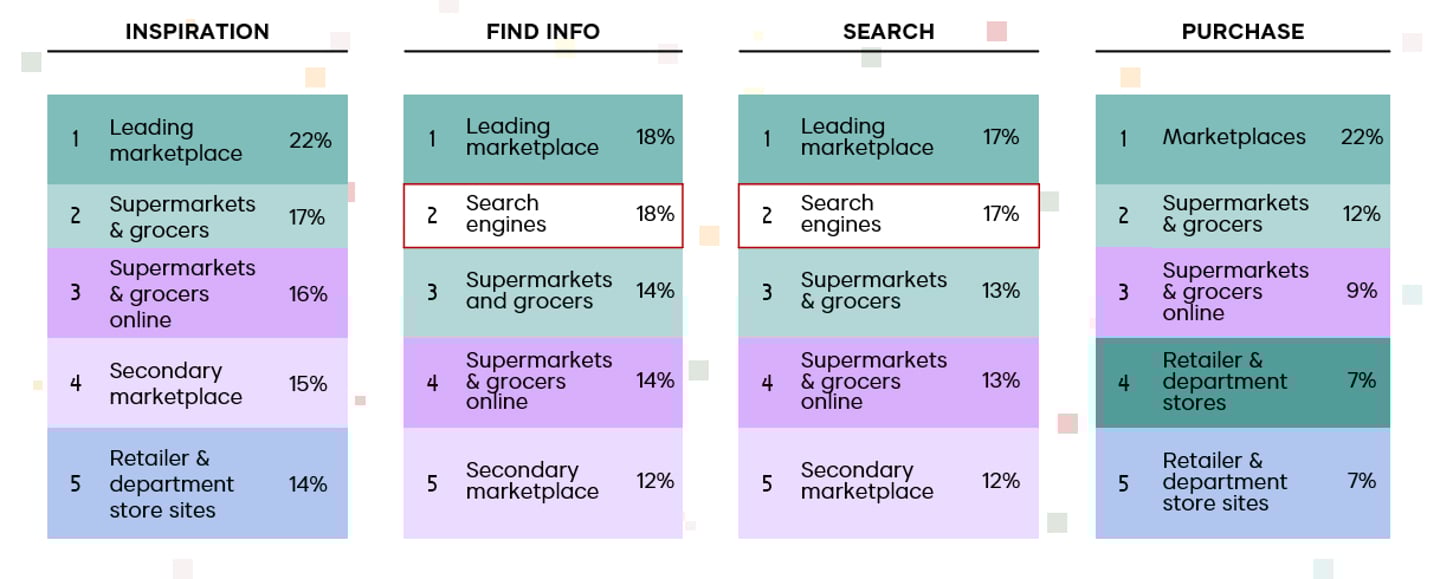
When it comes to inspiration, supermarkets and grocers are used by 17% of consumers while their online sites are used by 16%. For the information-gathering stage, both physical and online grocers account for 14%. For search that percentage is 13% for both physical and online. While when we look at the percentage of spend through these two channels, 12% goes through physical grocers and supermarkets and 9% through online supermarkets and grocers.
This omnipresence means that supermarkets and grocers contribute significantly to setting retail standards in terms of convenience, product availability and seamless experience. They have become one of the key players in setting the yardstick against which other retail experiences are measured.
The message is clear: The grocery shopper, driven by an insatiable appetite for immediacy, is inadvertently dictating the pace and expectations for the entire retail ecosystem. Brands and retailers in every sector must take note. The "two-hour economy" is here, and it's being shaped by the everyday demands of getting dinner on the table.
Those who can meet these elevated expectations, not just with cutting-edge technology but with a human-first approach that prioritizes convenience and trust, will be the ones to thrive in this rapidly evolving landscape. The future shopper isn't waiting. Are you ready to deliver?
About the Author
Hugh Fletcher is the global demand content and thought leadership director of VML Enterprise Solutions. He uses his client-side experience and unique take on the future of commerce to help organizations set up for, and implement, digital change in the constantly evolving commerce market.
Fletcher's work focuses on helping ambitious clients to transact more digitally through strategic consultancy, covering digital business transformation, the future of e-commerce and conversion.